
Honeywell Air Duct Cleaning in North Charleston: A Homeowner’s Guide
Honeywell makes thermostats that last decades and air purifiers that earn their shelf space. Their consumer duct cleaning attachments are a different story. Homeowners in North Charleston search for “Honeywell air duct cleaning” expecting a shortcut, then end up with a shop-vac hose duct-taped to a register and a weekend they’ll never get back. The gap between what a consumer kit can do and what professional extraction does isn’t small. It’s the difference between moving dust around and actually removing it.
Before you spend money on a product that can’t finish the job, it helps to understand what you’re really buying. And if you’d rather skip the trial and error, call (855) 683-7582.
What Are Honeywell’s Consumer Duct Cleaning Products, Really?
Honeywell’s homeowner-facing duct cleaning products are register-level attachments and small vacuum accessories designed to reach the first few feet of accessible ductwork. They’re built for light surface dust, not for extracting years of compacted debris from a full system. That’s the honest description, and it’s not a knock on Honeywell. It’s simply what the product category is engineered to do.
The limitation comes down to airflow. A typical household vacuum or shop-vac moves air in the low hundreds of cubic feet per minute at the hose, and much less once you factor in static pressure losses through a narrow attachment and a long flexible run. A professional truck-mounted negative pressure system pulls thousands of CFM while the duct run is under continuous vacuum. That’s not a marketing number. It’s the working principle behind the method.
Here’s what that means in practical terms for a North Charleston home:
- Reach: Consumer attachments can touch the register boot and a short stretch of trunk line. They can’t navigate the turns, wyes, and long horizontal runs that make up most of a Lowcountry home’s duct system.
- Agitation: Loose dust lifts easily. Caked-on debris, drywall dust from a recent renovation, and adhesive residue need mechanical agitation (a rotary brush) before vacuum can move them. A suction-only tool leaves the bonded layer behind.
- Containment: Consumer tools have no HEPA filtration and no sealed negative-pressure envelope. Whatever they disturb has to go somewhere, and that somewhere is usually your living room.
None of this makes the product defective. It makes it a dusting tool. If you’ve just had an air duct cleaning done professionally and want to keep registers tidy between service visits, a consumer attachment is a reasonable maintenance item. For anything beyond that, it’s the wrong tool for the job, and North Charleston homeowners deserve to know that before they buy.
What Consumer Tools Physically Can’t Extract
Three categories of duct contamination defeat consumer equipment regardless of brand or price point. They’re not marketing scare terms either. They’re the conditions professional crews encounter routinely in North Charleston homes, especially in older properties and houses that have been through a renovation.
Compacted debris. Over time, dust, pet hair, and construction particles settle and bond to duct walls, forming a layer that a suction-only tool can’t break loose. It has to be agitated with a rotary brush, then captured while airborne. Without that two-step process, you’re vacuuming the top millimeter and leaving the rest. The Sunstone Air Duct Cleaning approach uses Rotobrush rotary-brush systems for exactly this reason: the brush does the breaking, the HEPA extraction does the capturing.
Mold colonies. Mold needs moisture, and in a humid climate like North Charleston’s, moisture finds its way into ductwork through condensation, high indoor humidity, or a poorly sealed system. Mold growth anchors to duct liner and flex duct surfaces. Consumer vacuum attachments can’t remove it and can actually aerosolize spores if the tool lacks HEPA filtration. This is where Abatement Technologies-grade filtration equipment matters. It’s the same equipment category professional remediation crews use when mold is on the table.
Pest deposits. Rodents and insects leave droppings, nesting material, and contaminated debris in duct runs. This material carries health risks and should never be disturbed with a consumer tool that lacks sealed containment. It needs a professional assessment and proper extraction with HEPA-filtered equipment.
If any of these three sound familiar, a weekend project won’t solve it. Call (855) 683-7582 for a free estimate and a straight answer about what your ducts actually need.
Where Consumer Tools Actually Earn Their Place
We’re not here to tell you to throw away every consumer duct product. There are two situations where a homeowner-facing attachment has legitimate value, and both involve already-clean systems.
Spot-checking accessible registers. If you want to see whether dust is accumulating at a supply register in a North Charleston home, a consumer attachment is fine for a light once-over. It’s a visual check, not a cleaning. Think of it like wiping down a countertop: it doesn’t replace a deep clean, but it keeps things from getting worse between real cleanings.
Maintaining a recently cleaned system. After professional cleaning, a consumer attachment can help keep register grilles and the first foot of accessible duct tidy. This is maintenance-level work, and it’s where the product makes sense. The system is already clean, and you’re keeping it that way. That’s a fair use of a small tool.
What consumer attachments cannot do is substitute for a full-system cleaning on a system that has never been cleaned, has been through a renovation, or shows signs of contamination. If that’s your situation in North Charleston, the tool you need doesn’t come in a retail box. It comes on a truck.
How Professional Extraction Works Differently
Professional duct cleaning isn’t a bigger version of a consumer vacuum. It’s a different method entirely, and it’s the method the HVAC industry itself uses and recommends. The core elements are negative pressure, mechanical agitation, and HEPA-level capture, working together.
- Source containment. A large HEPA-filtered vacuum connects to the main trunk line and pulls the entire system into negative pressure. Every open register is now pulling air in, not leaking it out. Dust disturbed anywhere in the system travels toward the collector, not into your living room.
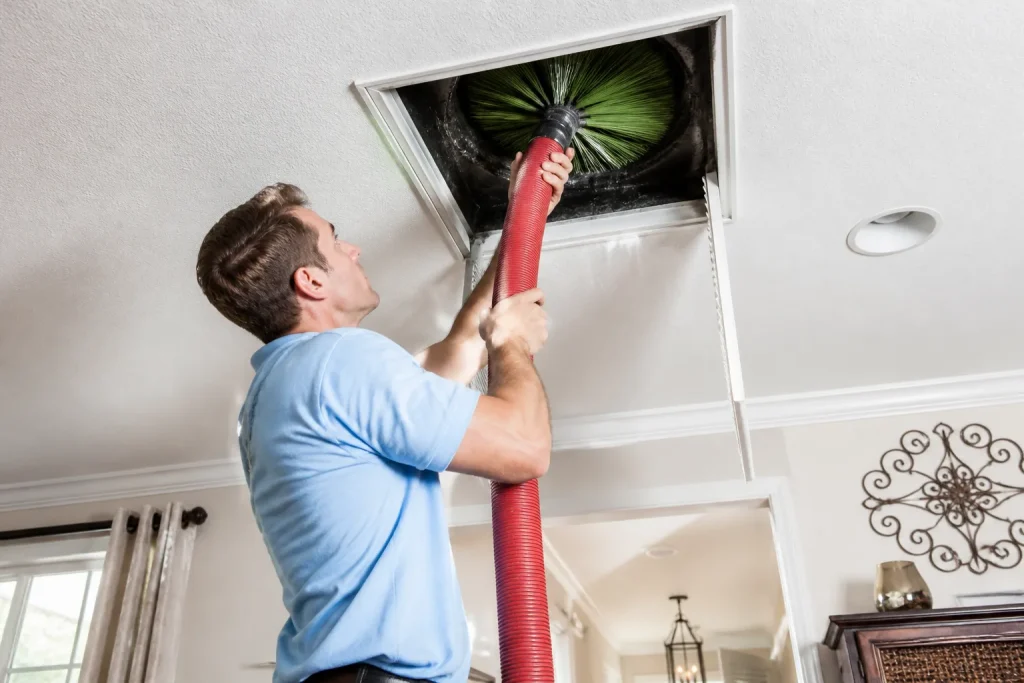
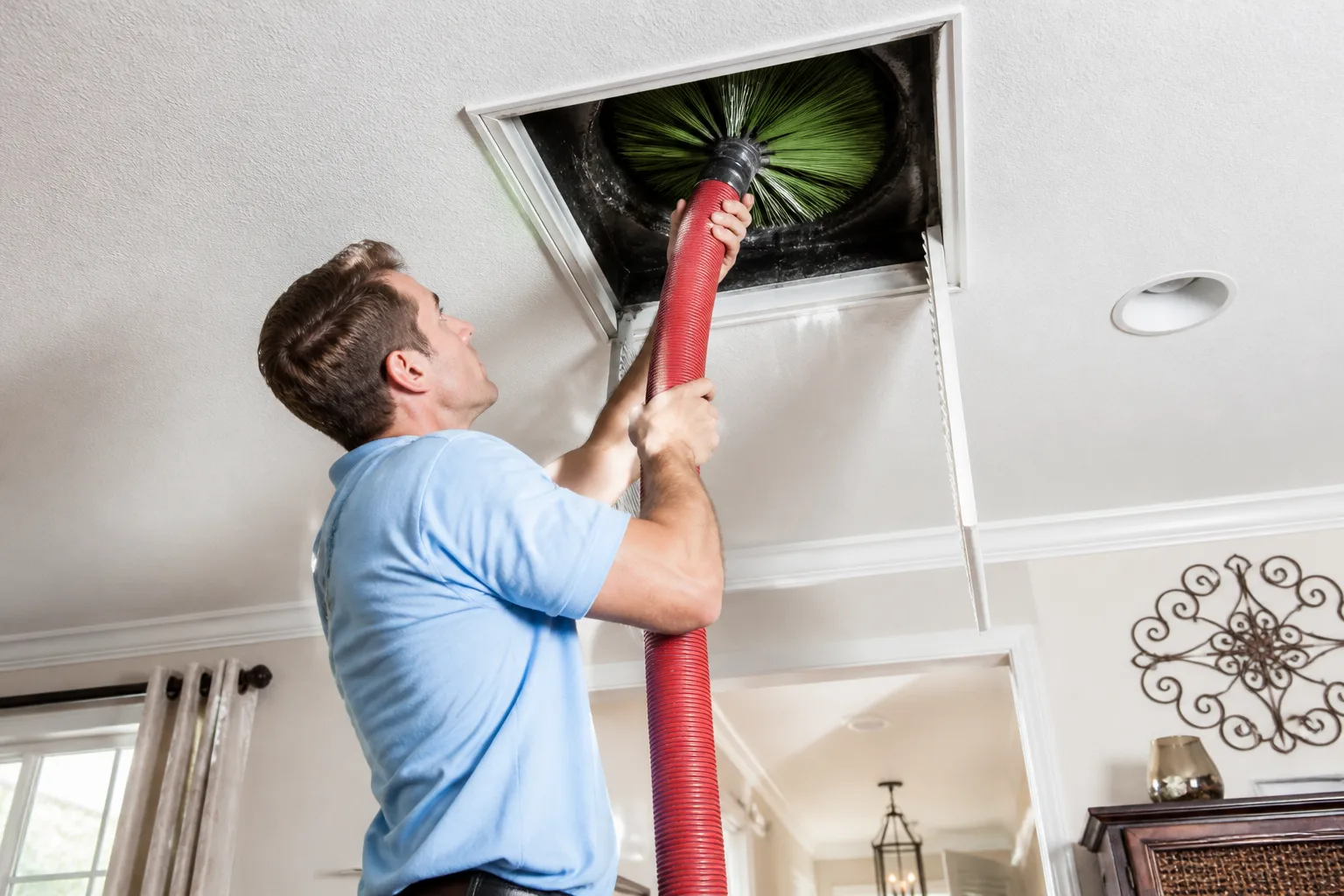
- Rotary brush agitation. A rotating brush head travels through the duct runs, breaking bonded debris loose from walls and liner. Rotobrush systems are built for this step, and it’s the part consumer tools simply cannot replicate.
- HEPA extraction. Nikro HEPA-filtered vacuum units capture the dislodged material at the source, including fine particulates that a standard filter would pass straight through.
- System inspection and repair. This is where professional cleaning pulls ahead of a straight vacuum job. Seams, joints, and flex duct connections get inspected for leaks and damage. If something’s failed, it gets repaired or noted, not left behind.
For a system that’s also home to a Honeywell or Aprilaire air quality component, the professional method has an added benefit: those systems work better when the ductwork they serve is clean. Professionals familiar with Aprilaire and Honeywell equipment understand how the components interact with the whole-home air path. Cleaning without that context is only half the job. If you suspect your ducts need sealing or repair alongside cleaning, a North Charleston inspection is the right starting point.
The Real Cost Comparison: DIY vs. Professional
Here’s the honest math most articles skip. A consumer duct attachment costs less up front, but that’s not the full calculation.
- DIY cost: The tool, plus your weekend, plus the risk of redistributing contaminants if agitation is inadequate or containment fails. Aerosolized dust and mold spores don’t get a do-over once they’ve settled on furniture and flooring.
- Professional cost: Priced per job by written estimate, agreed before work starts. One flat price per system, no per-vent charges, before-and-after photos of your own ducts so you can see what changed.
- The middle path: Paying for a consumer tool, discovering it can’t handle your system, then calling a professional anyway. That’s the most expensive option, and it’s the one most North Charleston homeowners end up on.
The other hidden cost is trust. This industry has a bait-and-switch reputation, and it’s earned. A low per-vent price that becomes a much larger invoice once the technician is on site is a familiar story. The fix is simple: insist on one flat price per system, agreed before work starts, with before-and-after photos. If a company won’t offer that in writing, keep calling. For a sense of what a full-system job actually involves, dryer vent cleaning is a useful parallel. It’s a smaller system, but the extraction principle is the same, and it addresses a leading cause of residential fires. Our technicians have up to 8 years of experience with the equipment and methods this work demands.
The Bottom Line
Honeywell’s consumer duct cleaning products are dusting tools, not extraction systems. They have real value for register-level maintenance on an already-clean system, and they fall short everywhere else: compacted debris, mold, pest deposits, and any duct run beyond the first few accessible feet. Professional truck-mounted negative pressure with rotary-brush agitation and HEPA capture is the method the HVAC industry uses for a reason, and no consumer attachment replicates it. For a system that needs real cleaning, plus duct repair if the inspection turns up damage, that’s the full-service scope worth paying for.
If you’re in North Charleston and want to stop guessing, Sunstone Air Duct Cleaning offers free estimates. One flat price per system, agreed before work starts, with before-and-after photos of your own ducts. Call (855) 683-7582. We answer 24/7. Fast dispatch from 7am to 7pm, Sunday through Friday.
Frequently Asked Questions
Yes, but only for light, register-level maintenance. A Honeywell consumer attachment can keep accessible registers tidy or clean the first foot of duct on an already-professionally-cleaned system. It can’t extract compacted debris, mold, or pest deposits from the full duct run. For that, you need professional rotary-brush and HEPA extraction equipment. Call (855) 683-7582 for an exact quote if you’re unsure which situation you’re in.
No. Honeywell-branded consumer products are homeowner tools for light surface dust. Professional duct cleaning uses truck-mounted negative pressure, rotary brush agitation, and HEPA-filtered capture to clean the entire system. They’re different equipment categories built for different jobs. If your ducts haven’t been cleaned in years or you’ve just finished a renovation, the consumer tool won’t get you there.
Usually because they’re not quoting the same job. A low per-vent price often covers only surface vacuuming, and the invoice grows once the technician is on site. A fair quote is one flat price per system, agreed before work starts, with before-and-after photos of your own ducts. Ask for that in writing. If a company won’t provide it, that’s your answer. Call (855) 683-7582 for a written estimate that covers the whole system.
Most homes can go several years between cleanings. More often if you’ve had a renovation, if there’s been water intrusion or mold, if you have pets or allergy sufferers in the home, or if pest activity has been an issue. Visual inspection is the best guide: heavy dust at registers, visible debris inside accessible ductwork, or musty odors when the HVAC runs all point to a cleaning being due.
Written by the team at Sunstone Air Duct Cleaning.
Need Air Duct Cleaning Help?
Call Sunstone Air Duct Cleaning - licensed & insured, with free written estimates in North Charleston.
(855) 683-7582